Title here
Summary here
The Airetos bundler consists of 3 main components:
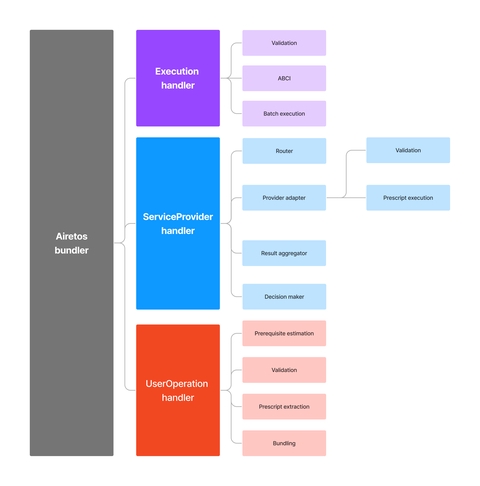
This component estimates all the necessary data required to execute the UserOperation (the bundled transaction) that users send to the bundler.
It calculates gas estimations, determines the appropriate paymaster (if applicable), and gathers any other prerequisite information.
The Validation component ensures that the UserOperation sent by the user adheres to the required format and meets all necessary criteria.
It performs various checks, such as verifying the validity of the sender’s account, checking the balance for gas fees, and ensuring the transactions are properly structured.
This component extracts the prescript (the auxiliary transactions for requested services like KYT or KYC) from the UserOperation.
It identifies the specific services the user wants to execute and separates them from the primary transaction.
After validation, the Bundling component adds the valid UserOperations to the bundler’s mempool (memory pool), where they await further processing.
The Router component analyzes the prescript data and routes it to the appropriate service adapter (e.g., KYT or KYC) based on the requested service.
Each service (KYT, KYC, or others) has a dedicated Adapter responsible for handling requests for that specific service.
Validation
Execution
The Aggregator collects and aggregates the results from multiple service executions (e.g., combining the results of KYT and KYC checks).
Based on the aggregated results from the Aggregator, the Decision Maker component determines whether to allow the primary transaction to proceed or halt it.
If the aggregated result is positive (e.g., the KYT and KYC checks are successful), the primary transaction is permitted to continue.
If the aggregated result is negative (e.g., one or more service checks fail), the Decision Maker halts the entire bundled transaction.
This component validates the UserOperations received from other nodes in the network to ensure consistency and prevent potential attacks.
The ABCI component facilitates communication between the bundler and the underlying consensus engine (Tendermint, in this case).
It allows the bundler to participate in the consensus process, share valid UserOperations with other nodes, and reach an agreement on the valid block containing the UserOperations.
The node responsible for producing the next block (the block producer) uses the Batch Execution component to send the UserOperations from its mempool to the Ethereum Virtual Machine (EVM) for execution on the blockchain.-
This component batches multiple UserOperations together for efficient execution and includes them in the new block.
We now have a blockchain network that generates blocks with a list of UserOperations in them.